
Put Debit Spread
Introduction to Put Debit Spreads Put Debit Spreads are a significant and strategic approach in options trading, commonly known as bear put spreads. This strategy involves purchasing a put option at a particular strike.
Introduction to Put Debit Spreads
Put Debit Spreads are a significant and strategic approach in options trading, commonly known as bear put spreads. This strategy involves purchasing a put option at a particular strike price while simultaneously selling a put option at a lower strike price on the same underlying asset and expiration date.
Key Takeaways
- Put Debit Spreads involve buying and selling put options on the same asset.
- They are cost-effective, with fees being a small percentage of the trade.
- The margin requirement is limited to the net premium paid.
- These spreads are used in bearish market conditions.
- The risk is limited to the premium paid, making it a controlled strategy.
- Real-life examples show how these spreads work in different market scenarios.
- Traders must understand the market and choose appropriate strike prices and expiration dates for success.
Understanding Put Debit Spreads
Put Debit Spreads involve a combination of put options. A put option gives the holder the right, but not the obligation, to sell a specified amount of an underlying security at a specified price within a specified time. This strategy is used when the trader anticipates a moderate decline in the price of the underlying asset.
Put Debit Spread Profit / Loss Diagram
Let's plot this strategy so we can visually see how the trade P/L performs (y axis), at expiration, given a particular stock price (x axis).
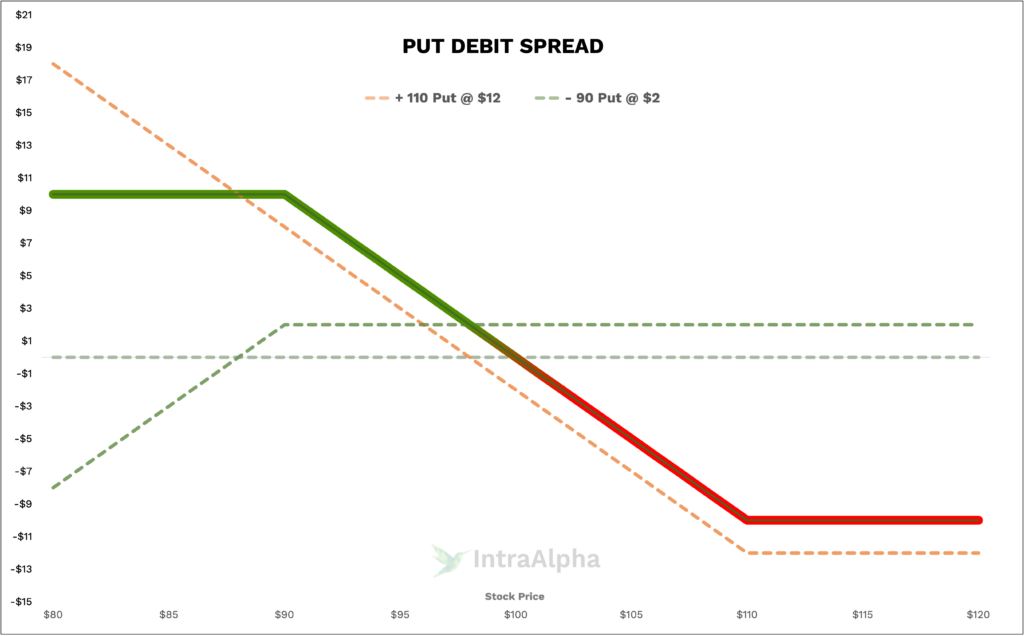
Here are the options represented in the graph above.
| - | Option 1 | Option 2 |
|---|---|---|
| Type | Put | Put |
| Long/Short | Long | Short |
| Strike | 110 | 90 |
| Premium | 12 | 2 |
| Quantity | 1 | 1 |
Long Put Debit Trades
In executing a long Put Debit Spread, consider a trade with XYZ Corp, whose stock is currently trading at $100. If you buy a put option with a strike price of $100 and sell another put with a strike price of $90, both expiring in 45 days, and the premium paid is $150 (representing a significant portion of the maximum loss), this positions you for a potential profit if XYZ declines in price.
Commissions and Fees with Put Debit Spreads
Trading Put Debit Spreads can be relatively cost-efficient. Assuming each leg incurs a $1 fee, a round-trip trade would cost $4. If the total premium paid is $150, the fees represent about 2.67% of the total trade cost, which is modest compared to the overall value of the trade.
Margin Impact of Put Debit Spreads
Using the XYZ Corp example, the impact on margin is limited to the cost of the spread (the net premium paid). Since XYZ is trading at $100, and if you have engaged in a spread that costs $150, your margin requirement would essentially be the cost of entering the trade.
Benefits and Risks of Put Debit Spreads
Put Debit Spreads offer a controlled risk profile, as the maximum loss is limited to the net premium paid. However, the trade-off is that potential profits are also capped. The risk is the spread between strike prices minus the net premium paid.
Proven Tips for Success with Put Debit Spreads
Success in trading Put Debit Spreads requires a good understanding of market trends and choosing the right strike prices and expiration dates. Monitoring market conditions and being prepared to adjust your strategy as needed is crucial.
Real-Life Put Debit Spread Examples
Using the earlier XYZ Corp example, if the stock price falls below the $90 strike price at expiration, the maximum profit is realized. However, if the stock price is above the $100 strike price, the options expire worthless, and the loss is limited to the premium paid.
When and Why Traders Use Put Debit Spreads
Traders use Put Debit Spreads in bearish market conditions, expecting a moderate decline in the underlying asset's price. They are used to capitalize on downward movements while limiting risk exposure.
How do Put Debit Spreads Work?
Put Debit Spreads work by purchasing a put option at a higher strike price and selling another put option at a lower strike price. The trader pays a net premium for the position, representing the maximum potential loss.
Are Put Debit Spreads Risky?
While Put Debit Spreads limit potential losses to the premium paid, they are not without risk. The primary risk is the loss of the premium if the market does not move as anticipated.
Are Put Debit Spreads Bearish or Bullish?
Put Debit Spreads are generally considered bearish as they profit from a decline in the underlying asset's price.
Conclusion
Mastering Put Debit Spreads is crucial for traders looking to capitalize on bearish market trends while managing risk. By understanding when and why to use them, along with the associated costs and margin requirements, traders can strategically position themselves for potential profits. For more support in trading Put Debit Spreads, message us on X.com or Discord.