
Iron Butterfly
Introduction to the Iron Butterfly The Iron Butterfly is a unique options trading strategy, pivotal for investors seeking to capitalize on limited stock price movement. This strategy, also known as the "Ironfly,".
Introduction to the Iron Butterfly
The Iron Butterfly is a unique options trading strategy, pivotal for investors seeking to capitalize on limited stock price movement. This strategy, also known as the "Ironfly," combines both call and put options to create a position with limited risk and potential profit. The Iron Butterfly is particularly notable for its application in markets with low volatility.
Key Takeaways
- The Iron Butterfly is ideal for low-volatility market conditions.
- It involves buying and selling calls and puts with different strike prices but the same expiration.
- The strategy's profitability hinges on the stock price remaining near the middle strike price at expiration.
- Commissions and fees can significantly impact the net profitability of Iron Butterfly trades.
- It's crucial to understand the margin requirements and manage risks effectively.
- Iron Butterflies are best suited for neutral market views, neither bullish nor bearish.
- Success with this strategy requires careful market analysis and risk management.
Iron Butterfly
Understanding Iron Butterflies
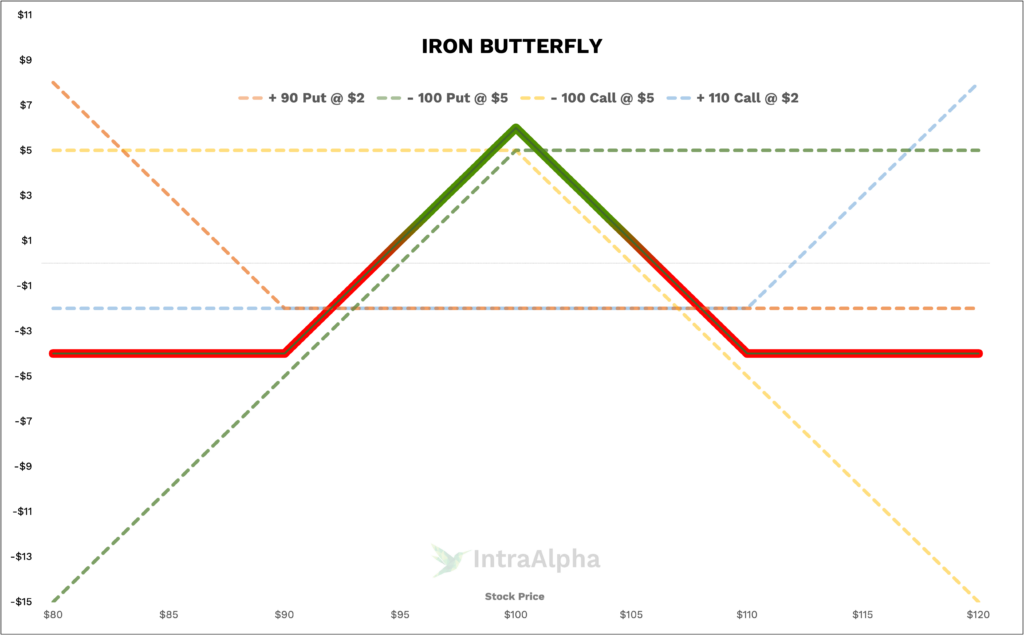
At its core, an Iron Butterfly involves four options contracts: buying and selling both calls and puts with the same expiration date but at different strike prices. This creates a combined position with a net premium that is a credit to the trader's account. The maximum profit occurs when the stock price is equal to the middle strike price at expiration, while the loss is limited to the difference between adjacent strike prices minus the net premium received.
Long Iron Butterfly Trades
Let's consider a hypothetical trade with XYZ Corp, currently priced at $100. In a long Iron Butterfly, an investor might buy a $90 put, sell a $100 put, sell a $100 call, and buy a $110 call. If the premium collected totals $450, the maximum loss (excluding commissions and fees) is the difference between strike prices ($1000) minus the $450 premium, resulting in a $550 risk. This strategy shines when the investor anticipates little to no movement in the underlying stock.
Commissions and Fees with Iron Butterflies
Iron Butterfly trades involve four separate options transactions, potentially leading to higher commission costs compared to simpler strategies. Assuming a $1 fee per leg, a round-trip trade costs $8. If the total premium is $450, these fees constitute about 1.78% of the trade's total value, a significant factor to consider when calculating potential net returns.
Margin Impact of Iron Butterflies
Using the XYZ Corp example, the margin requirement is typically the maximum potential loss of the trade. So, for an Iron Butterfly with a $550 potential loss, this amount would be reserved in the trader's account, impacting the available margin for other trades.
Benefits and Risks of Iron Butterflies
The primary advantage of an Iron Butterfly is the limited risk and potential for profit in a stable market. However, the risks include potential losses up to the maximum defined limit and higher commission costs due to multiple transactions.
Proven Tips for Success with Iron Butterflies
Success with Iron Butterflies involves careful market analysis, precise timing, and thorough understanding of the underlying asset. Monitoring market volatility and exiting the position before expiration can also be crucial for mitigating losses and locking in profits.
Real-Life Iron Butterfly Examples
Returning to the XYZ Corp scenario, if the stock remains near $100 at expiration, the Iron Butterfly reaches its maximum profit potential. However, significant movement in either direction reduces the profitability, emphasizing the strategy's dependence on market stability.
When and Why Traders Use Iron Butterflies
Traders typically deploy Iron Butterflies in low-volatility markets, expecting the underlying asset to exhibit minimal price movement. This strategy is often used when a trader predicts a stable price but wants to hedge against slight fluctuations.
How do Iron Butterflies Work?
An Iron Butterfly works by creating a position that profits from the stagnation of the underlying stock price while limiting potential losses. The sold calls and puts bring in premium, which is the trader's maximum gain, while the bought options define the risk boundaries.
Are Iron Butterflies Risky?
While the Iron Butterfly limits potential losses to a predefined amount, it is still subject to risks, particularly if the market moves significantly. The risk-to-reward ratio is an essential consideration in this strategy.
Are Iron Butterflies Bearish or Bullish?
Iron Butterflies are neither inherently bullish nor bearish. They are best suited for neutral market outlooks, where the trader expects little movement in the underlying asset's price.
Conclusion
Mastering the Iron Butterfly in options trading requires an understanding of market dynamics and a strategic approach to risk management. While offering limited risk and potential profit in stable markets, it demands careful consideration of commissions, fees, and margin requirements. If you need assistance with your trading strategies, don't hesitate to message us on X.com or join our Discord community for more support.